|
Chris Feng Hi there! I am a Research Assistant at the Machine Learning Department, Carnegie Mellon University. I am advised by Prof. Barnabas Poczos and Prof. Nicholas M. Boffi. I obtained my master's degree from Carnegie Mellon University, where I was fortunate to be advised by Prof. Zackory Erickson to work on signal processing research in Robotic Caregiving and Human Interaction Lab, Robotics Institute. My research interests focus on AI for Science, generative models, and interpretable deep learning. I am particularly interested in:
Email is the best way to reach me and please feel free to send me an email to discuss research! I try to read all my emails carefully, but don't hesitate to send another one if you don't receive my reply after one week! |

|
ResearchI have primarily focused on flow-based deep learning models, representation learning, and AI for drug design. I am also broadly interested in the applications of machine learning across various academic fields. |
|
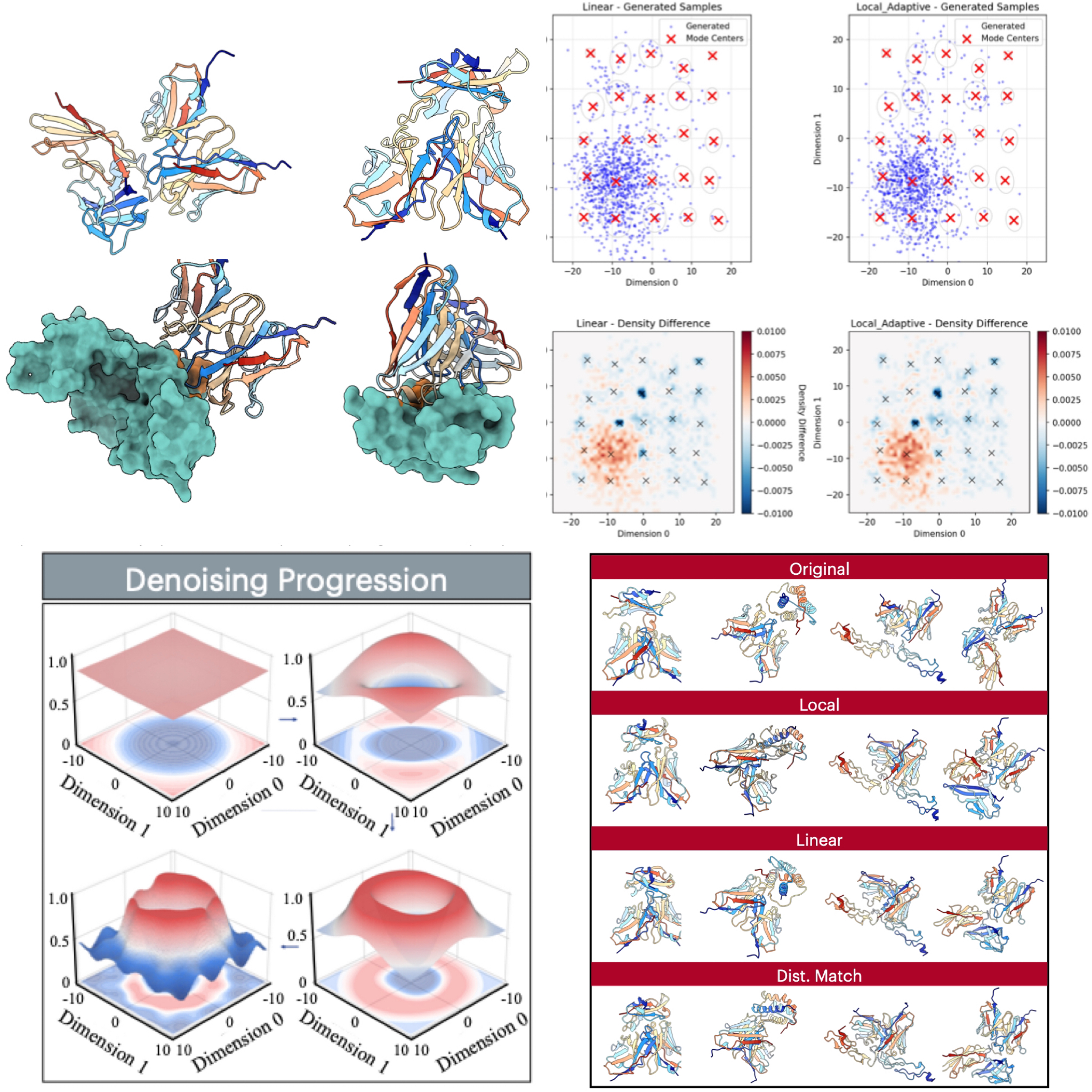
Soft Metropolis-Hastings Correction for Generative Model Sampling
H Feng*, P Qiu*, M Zhang*, Y Fan, Y Tao, B Poczos Under review by ICLR, 2025 Molecular diffusion models suffer from systematic sampling biases that trap molecules in local energy minima. We introduce soft Metropolis-Hastings correction that replaces binary acceptance with continuous interpolation, maintaining smooth navigation while providing principled bias correction. Our method employs three molecular-specific variants and consistently improves chemical validity, structural stability, and conformational quality across small molecules, drug conformations, and therapeutic antibody CDR-H3 loops. |
|
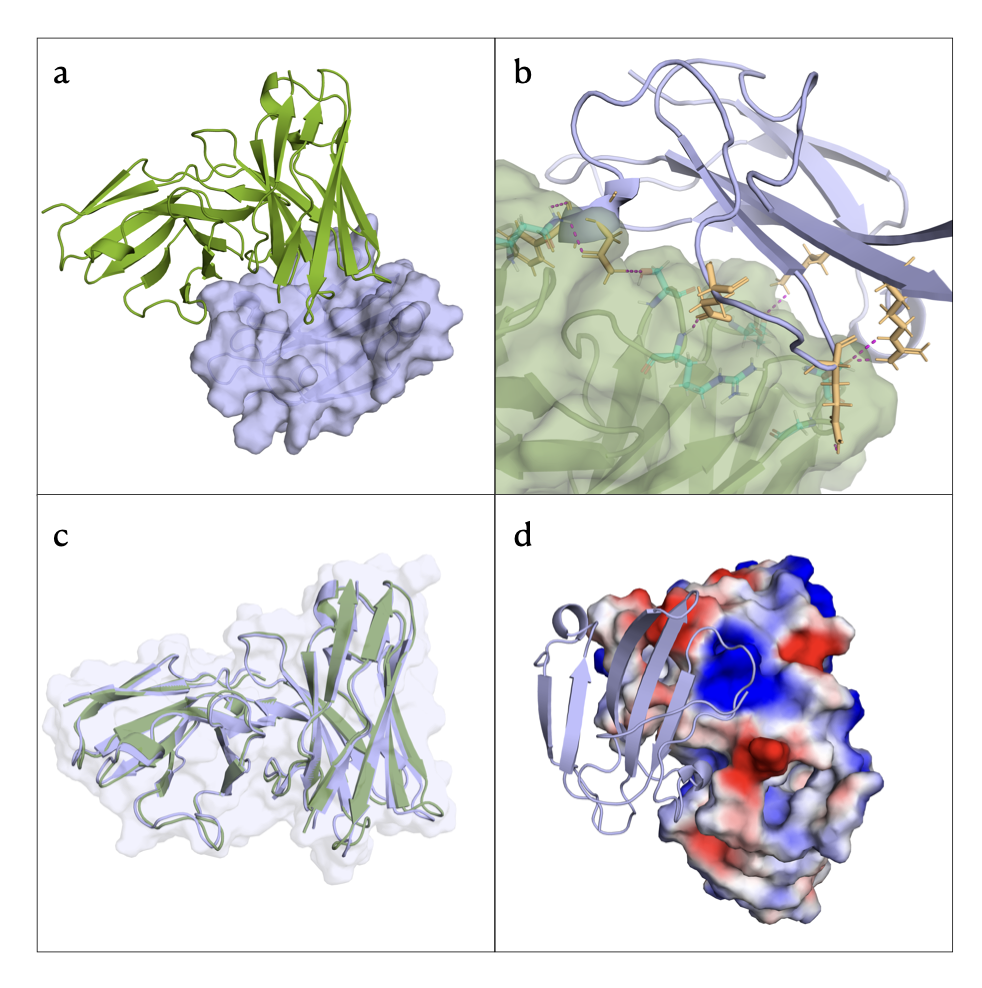
Learning from B Cell Evolution: Adaptive Multi-Expert Diffusion for Antibody Design via Online Optimization
H Feng*, P Qiu*, Y Tao, M Zhang*, Y Fan, J Xu, B Poczos NeurIPS 2025 Workshop Inspired by B cell affinity maturation, we propose the first biologically-motivated framework that leverages multiple specialized experts whose parameters evolve during generation based on iterative feedback. Our adaptive guidance discovers personalized SE(3)-equivariant optimization strategies for each target, significantly enhancing hotspot coverage and interface quality through target-specific adaptation. |
|
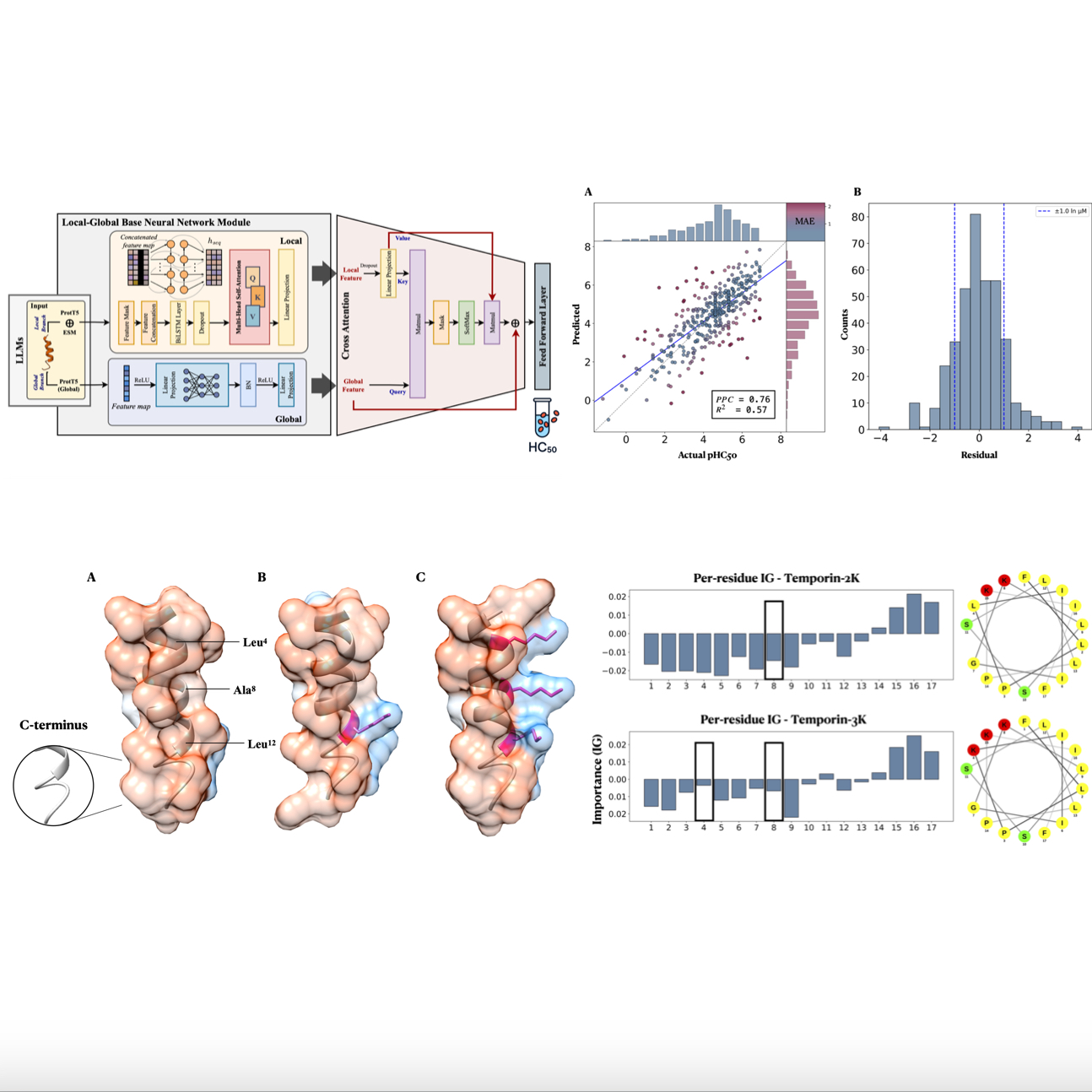
AmpLyze: A Deep Learning Model for Predicting the Hemolytic Concentration
P Qiu*, H Feng*, M Zhang*, B Poczos Accepted to BIBM 2025 AmpLyze predicts the actual HC50 value from sequence alone, closing the gap between binary toxicity classification and quantitative safety assessment. By coupling residue-level embeddings with sequence-level descriptors through cross-attention, our model achieves PCC of 0.756 and provides interpretable attribution to guide safer AMP design. |
|
Website template from Jon Barron |